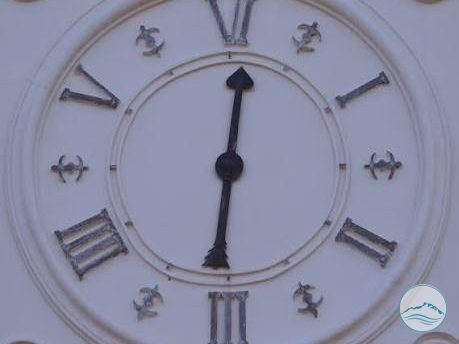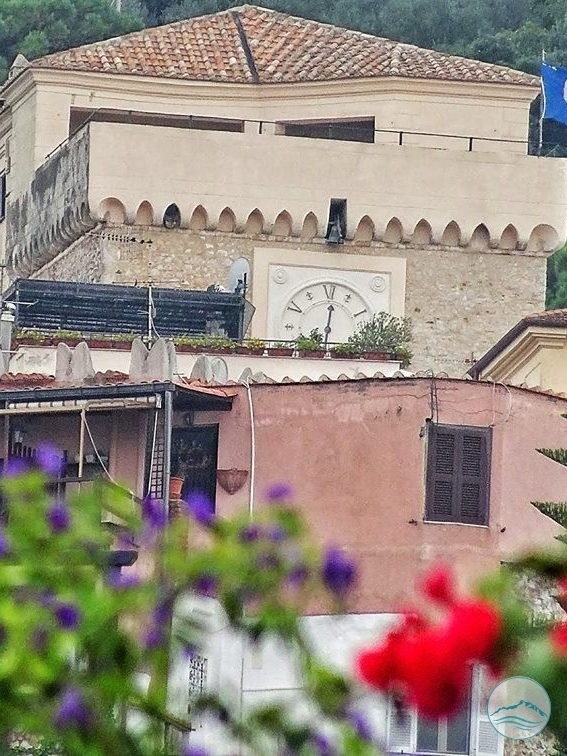
A distinctive six-hour clock, installed on the tower in the early 1800s by Prince Stanislao Poniatowski: its dial bears only six numerals, and its single hand makes four complete turns over the twenty-four hours, marking time with a hammer that strikes a small bell. This way of measuring time, used in the territories of the Papal States in the 17th and 18th centuries, is rare today and makes for a fascinating historical curiosity for anyone exploring the historic centre of Circeo.
High up on the 13th-century Templar Tower sits an imposing and rare clock. It dates back to the 17th century and originally stood at the centre of the defensive wall of the baronial palace. It owes its present position to Prince Stanislao Poniatowski, who in 1800 had it moved so that the townspeople could see it. The move took place while the baronial palace was being raised: a new storey was added to the Templar tower as well, and the gears that drove the striking mechanism were housed inside it.
This is a very rare weight-driven clock with one unusual feature: time is told by a single hand that meets not twelve numerals on the dial but only six, going round them four times over the 24 hours. The hour is announced by a small hammer that strikes a bell set just above the clock. Each strike is repeated a minute later, to remind anyone who wasn’t paying attention the first time. In the past, the clock was set precisely using the sundial on the baronial palace (recently restored). Engraved on the mechanism is the inscription: “Joannes De Franchis, Romanus fecit 1769”.