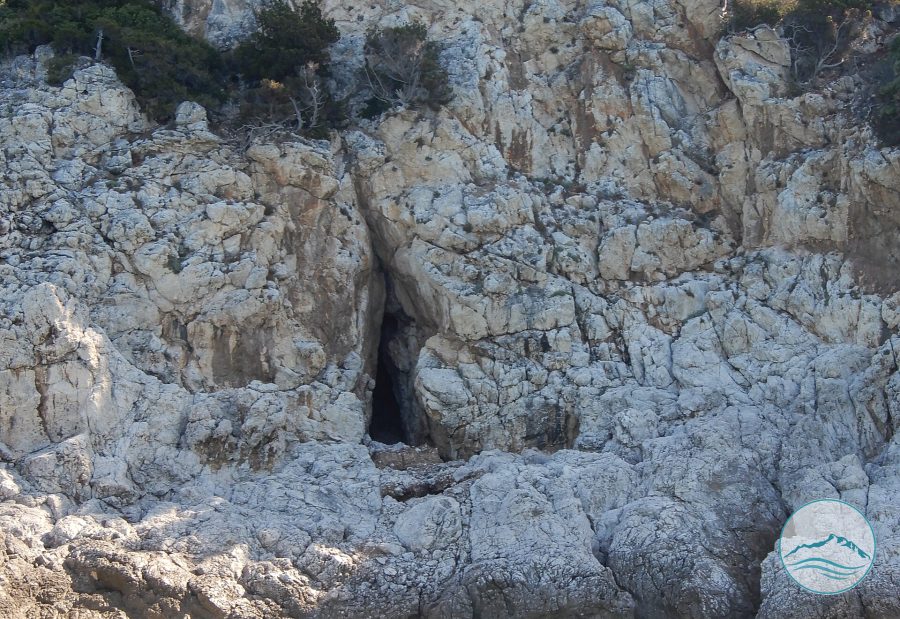
On the western side of the promontory, about 20 metres above sea level, past the Batterie fort and near the old alabaster quarry, lies a rock overhang sloping at 45° known as “Riparo Blanc” (the Blanc Rock Shelter).
It was identified in 1959 by the archaeologist Marcello Zei, who named it in honour of the eminent scholar Alberto Carlo Blanc.
The site was studied by the Italian Institute of Human Palaeontology in Rome between 1960 and 1963, under the direction of Cardini and Taschini.
The finds were plentiful: a vast quantity of molluscs (over 30,000 shells), mostly limpets and top snails (Trochus), along with remains of fish and crustaceans (crabs above all) and stone tools, including flint awls and denticulates and various obsidian flakes.
At the base of the shelter, excavators identified a first layer dating to the Epipalaeolithic and a second layer bearing witness to a Mesolithic human settlement.
A more recent interpretation sees Riparo Blanc as a specialised seasonal camp for gathering shellfish from the rocks; carbon-14 dating places human activity at the site at around 8,500 years before the present, confirming that the remains belong to the Mesolithic.
The site has been badly damaged by the many unauthorised digs carried out carelessly by curious visitors, yet it remains a truly evocative spot, especially at sunset, when the sky turns a beautiful red.